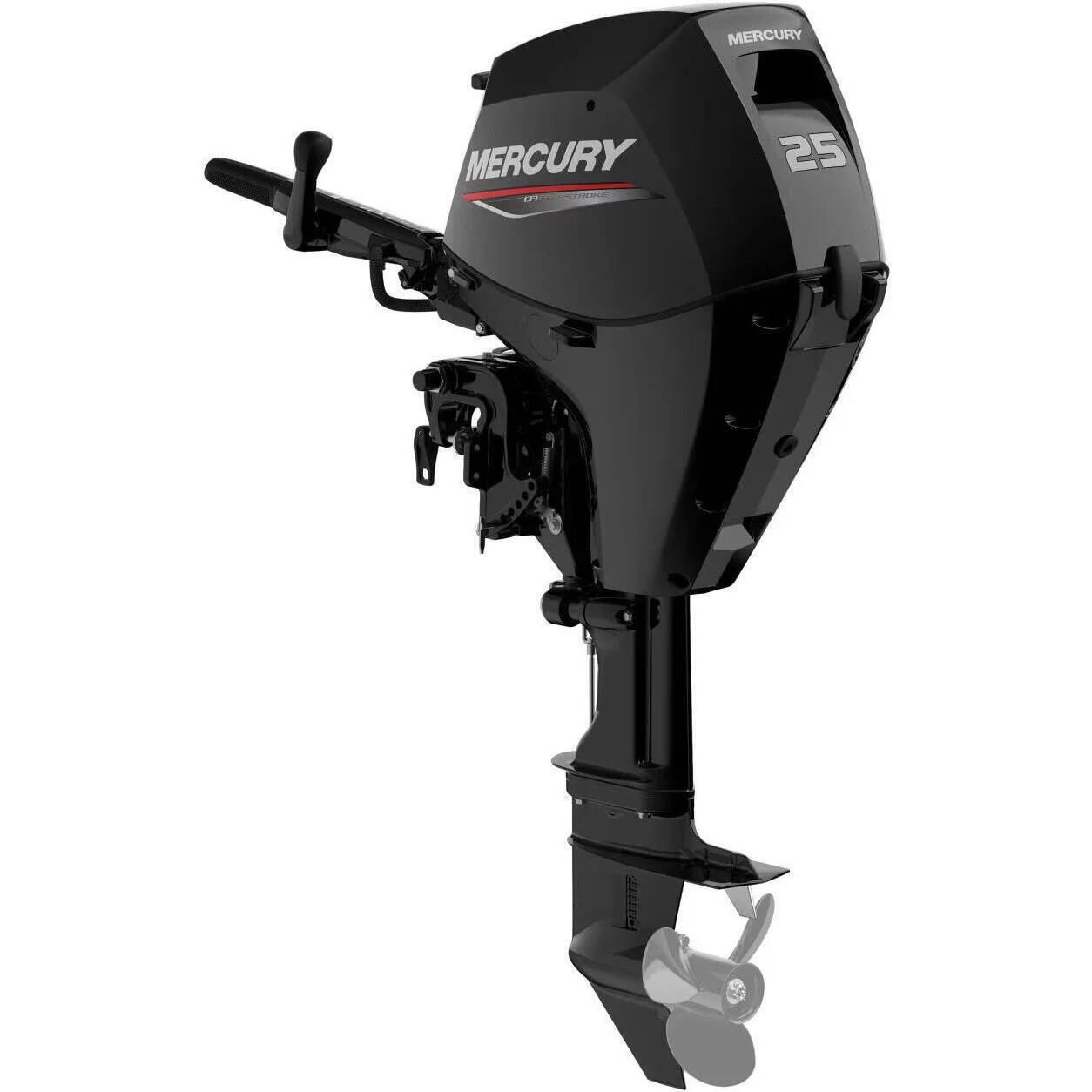
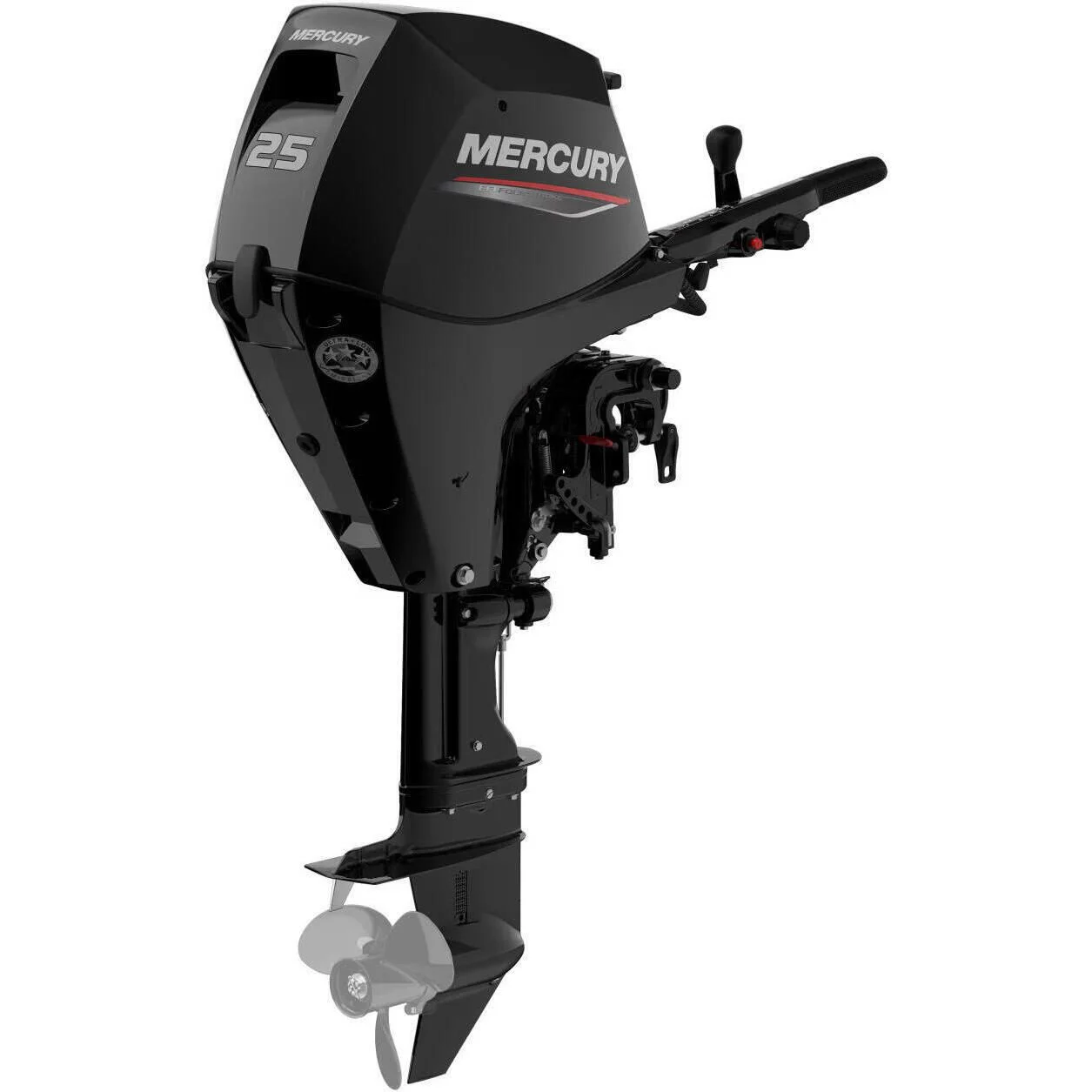
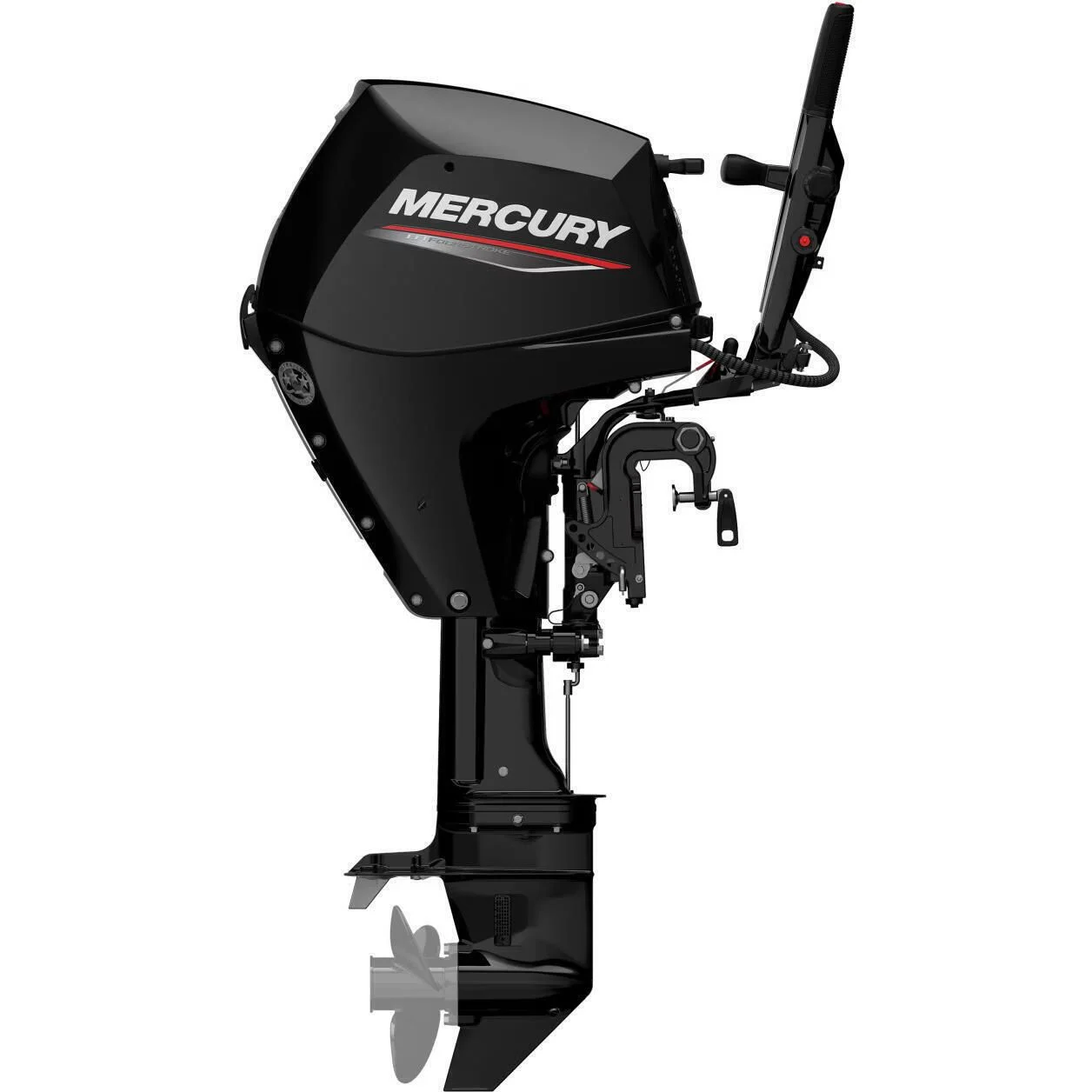
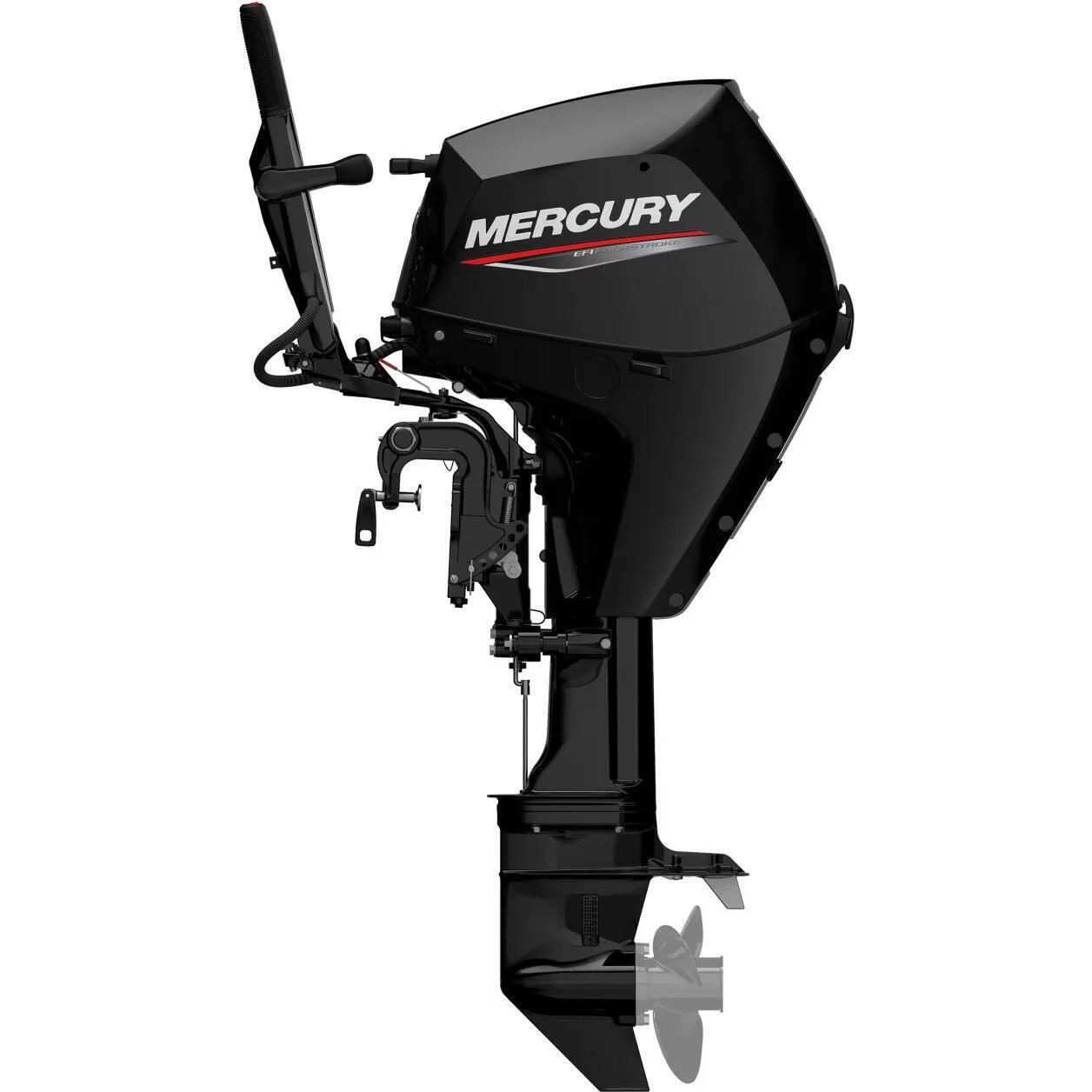

Description
Why Three Cylinders Change the Engine
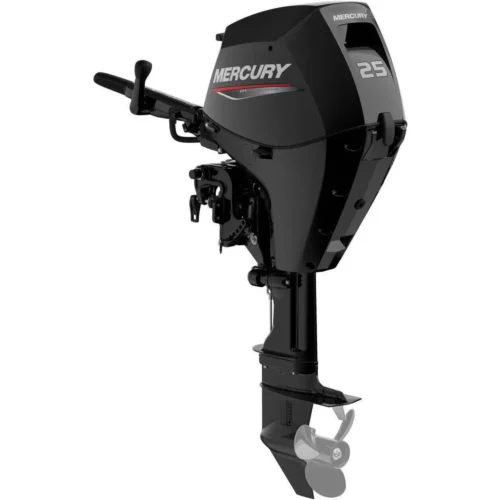
Every Mercury below 25 HP is either a single or a twin engine. The 25 HP is the first three-cylinder, and that is the real story of this engine rather than the five horsepower it adds over the 20.
Three cylinders are inherently better balanced than two. A twin fires twice per crankshaft revolution with the pistons working against each other in a way that produces a rocking couple, which is why every twin needs balance shafts or counterweights and still transmits some vibration. A triple fires three times per revolution at 120-degree intervals, which cancels out far more cleanly. You feel it as an engine that hums rather than thrums, and over a full day at the tiller, that is the difference between finishing comfortably and finishing worn out.
The second consequence is torque delivery. Extra displacement spread across three smaller cylinders produces usable torque lower in the rev range than a twin working at the same output. Mercury’s own positioning for this engine is low-end torque that smartly puts the boat on plane, and that is an accurate description of what it does. A loaded 16 to 18-foot hull gets up and over the transition without the long, bow-high wallow you get from an underpowered twin.
Because the engine is not straining for its rating, it also lasts. An engine working at 70 percent of its comfortable output all day accumulates wear far more slowly than one working at 95 percent.
Battery-Free EFI and Electrical Support
Mercury’s battery-free EFI extends to this engine on manual-start models. The engine generates the electrical power to run the injection system from the recoil pull, so you get injection reliability without carrying a cranking battery on a boat that may not have anywhere sensible to put it.
On electric-start models, a high-output alternator keeps a battery charged and supports fishing electronics: a sounder, a chart plotter, a live well pump, and navigation lights can run together without draining the start battery. On a fish and ski or rigged aluminum console boat, that capability is the reason to specify electric start rather than just the convenience of a key.
The engine protection system is more comprehensive than anything lower in the range, monitoring low oil pressure, over-rev, overheating, and sensor failure. Four monitored conditions rather than two, which is appropriate for an engine that will spend more of its life at sustained load.
Tiller or Remote, and Which to Choose
The 25 HP is the point in the range where remote steering becomes a genuine option rather than an afterthought. Mercury offers both.
Choose the tiller if your boat is an open aluminum or jon layout and you fish from the stern. The Mercury tiller runs close to 23 inches, reverses for left- or right-handed throttling, and adjusts laterally, which gives precision handling you cannot get from a wheel.
Choose remote steering if your boat has a console, if you carry passengers forward, or if you run distance. Steering from the helm on a 17-foot hull is simply more comfortable than sitting at the transom for an hour.
Decide before you order. Converting a tiller model to remote after the fact means a control box, cables, a steering system, and labor, and it costs considerably more than specifying it correctly at purchase.
Trim has six positions, with power trim and tilt available. Exhaust runs through the propeller hub. Cooling is thermostatically controlled. Saltwater rated from the factory.
Every Mercury 25 HP outboard we ship is new, factory sealed, and pre-delivery inspected before crating. Compare the full Vast Versatility range, step down to the Cool Compacts range, or browse the Mercury outboard motors hub for larger sizes. For hull matching, see our pontoon boats and rigid-hull inflatables. The direct cross-brand comparison in stock is the Yamaha 25 HP outboard motor.
Mercury 25 HP Four-Stroke EFI: Full Factory Specifications
| Feature / Specification | Technical Detail / Value |
|---|---|
| Models | 25MH, 25MLH, 25EH, 25ELH, 25ELPT |
| Horsepower | 25 HP |
| Engine type | Inline 3-cylinder, four-stroke |
| Displacement | 500 cc / 30.5 CID |
| Bore | 61 mm / 2.40 in |
| Full throttle RPM range | 5400 to 5800 rpm |
| Fuel induction | 2 valves per cylinder, single overhead cam (SOHC) |
| Fuel system | Electronic fuel injection (EFI), battery-free on manual start |
| Recommended fuel | 87 octane, up to 10% ethanol |
| Recommended oil | Mercury FourStroke 10W-30 |
| Ignition | CDI with electronic spark advance |
| Cooling system | Water-cooled with thermostat |
| Alternator | High-output (electric start models) |
| Starting | Manual or electric (turn-key) |
| Steering | Tiller (approx. 23 in., reversible grip) or remote |
| Gear shift | Forward, Neutral, Reverse |
| Gearcase ratio | 2.17:1 |
| Shaft lengths | 15 in / 381 mm, 20 in / 508 mm |
| Trim system | 6 positions, power trim, and tilt available |
| Shallow water trim range | 16 degrees |
| Exhaust system | Through the propeller |
| Remote fuel tank | 3.2 gal / 12 L, standard |
| Dry weight | 132 lb / 60 kg (lightest configuration) |
| Engine protection | Low oil pressure, over-rev, overheating, sensor failure |
| CARB star rating | 3 stars |
| Color | Phantom Black |
| Saltwater rated | Yes. |
| Warranty | Mercury 3-year |
| Condition | New, factory sealed, PDI completed |
Frequently Asked Questions
Why is the Mercury 25 HP a three-cylinder engine?
Three cylinders balance better than two. A twin produces a rocking couple that transmits vibration through the tiller and the transom, while a triple fires at 120-degree intervals, which cancels far more of it. The three-cylinder layout also delivers torque lower in the rev range, so a loaded hull comes onto the plane without straining the engine. The 25 HP is the smallest Mercury FourStroke built this way.
Should I order the Mercury 25 HP with a tiller or remote steering?
Order a tiller steering if your boat is an open aluminum or jon layout and you operate from the stern, since the roughly 23-inch adjustable tiller provides precision handling that a wheel cannot match. Order remote steering if you have a console, carry passengers forward, or run distance. Converting between the two after purchase requires a control box, cables, and a steering system, so decide before ordering.
Does the Mercury 25 HP need a battery?
Not on manual-start models. Mercury’s battery-free generator generates the electrical power to run fuel injection from the recoil pull itself, so no cranking battery is needed. Electric-start models require a battery and carry a high-output alternator that supports fishing electronics, a live well pump, and navigation lights alongside charging.
What size boat does a 25 hp outboard suit?
A 25 hp outboard suits aluminum tiller and console boats, jon boats, utility craft, and fish and ski hulls from roughly 16 to 18 feet. With three or four people and gear aboard, the three-cylinder torque puts the hull on plane where a 20 HP twin would labor. It also serves as capable auxiliary power on larger displacement craft.
What is the difference between the Mercury 20 HP and 25 HP?
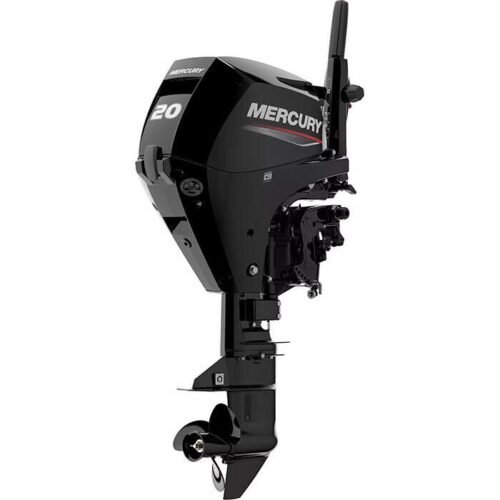
The 20 HP is a 333cc twin at 99 lb. The 25 HP is a three-cylinder engine with more displacement, better balance, and more low-end torque, at a higher weight. The jump is not five horsepower; it is a change of engine class. Choose the 20 HP for hulls to 18 feet with light loads, and the 25 HP for heavier loads, more passengers, or where remote steering is wanted.