
Description
Three Genuine Industry Firsts
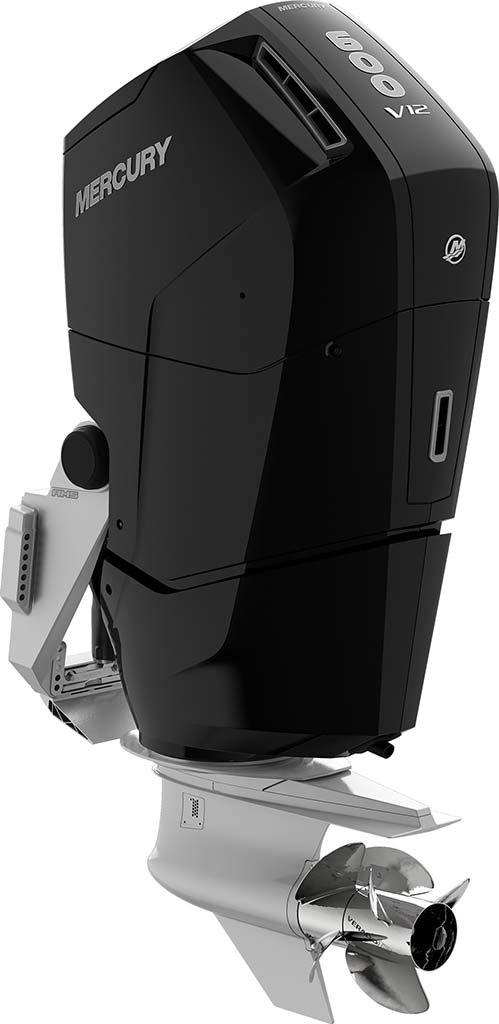
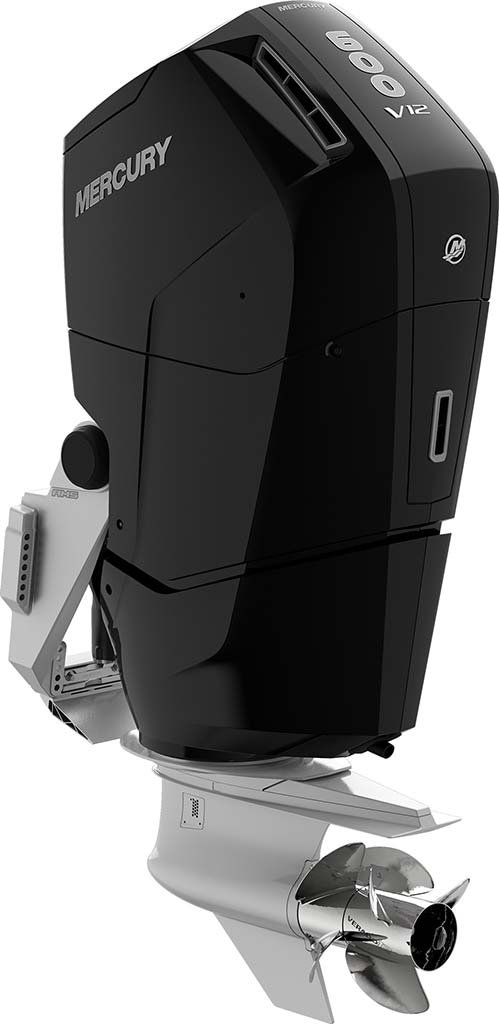
Most outboards differ from each other by degree. The Verado 600 differs by kind, and it is worth walking through why.
The two-speed automatic transmission. Every other outboard in production has one gear ratio, which forces a compromise: gear it low and you plane well but give up top speed, or gear it high and you run fast but struggle to get there. The Verado 600 carries two ratios and shifts automatically between them. At low revs it runs 1.75:1, multiplying torque like first gear in a car to pop a heavy hull onto a plane. Once planning, it changes to 2.50:1 for efficient cruising. You get both behaviors from one engine.
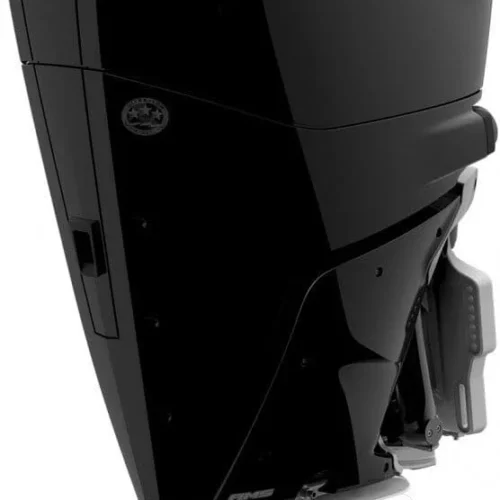
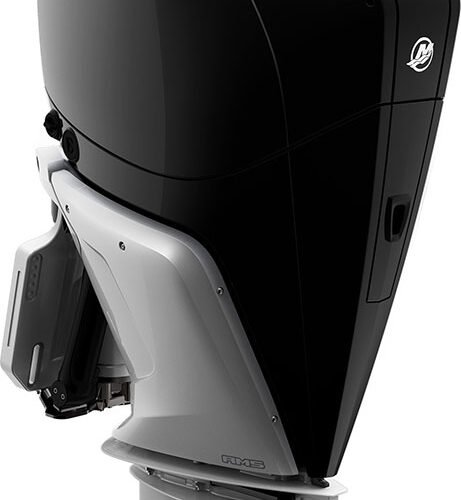
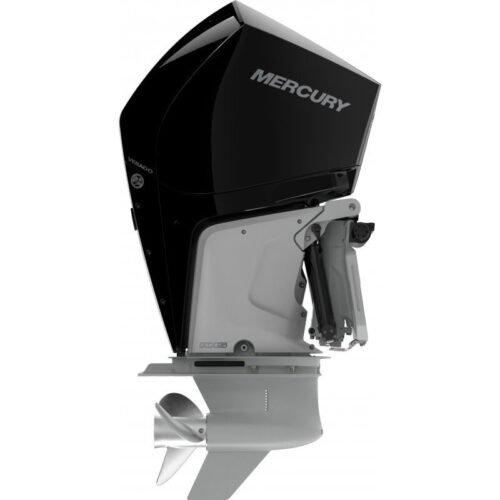
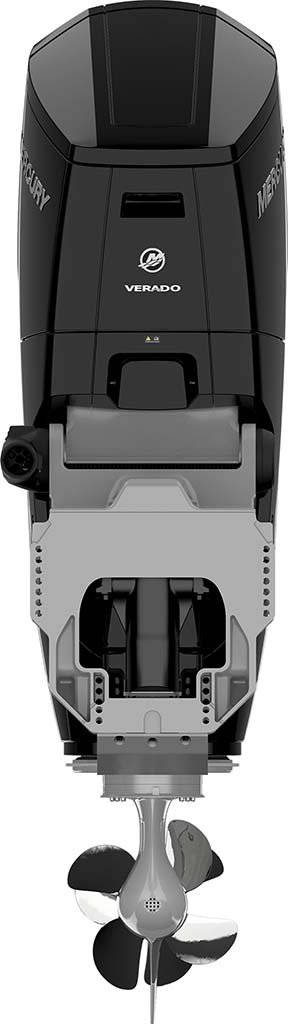
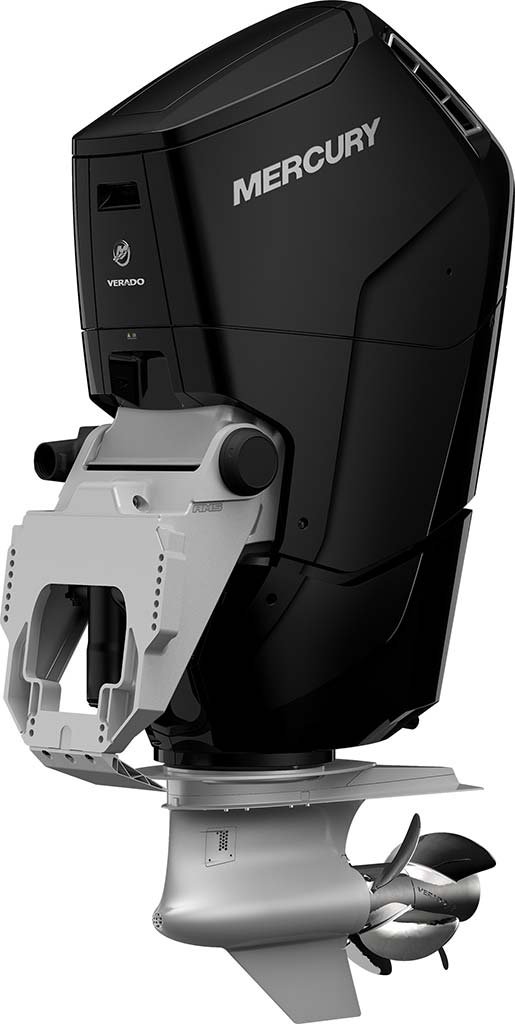
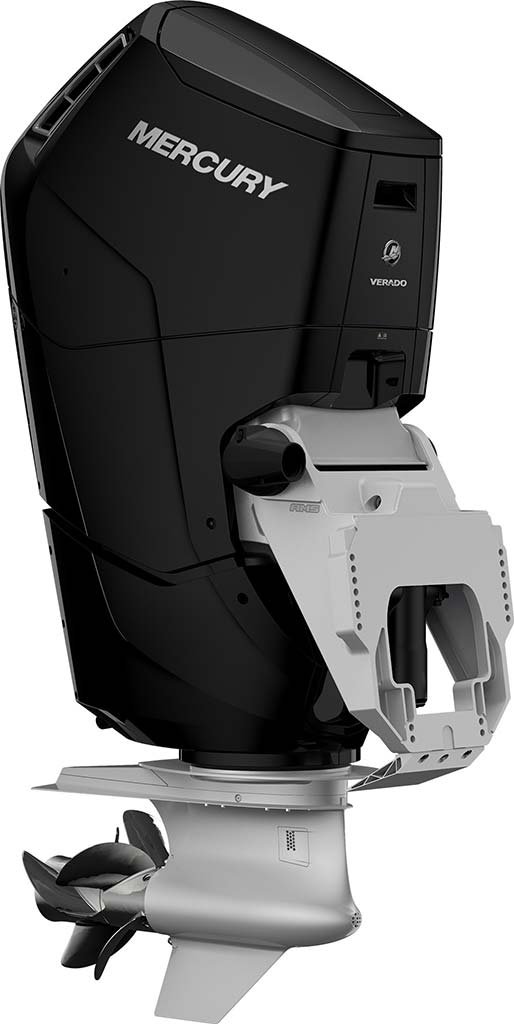
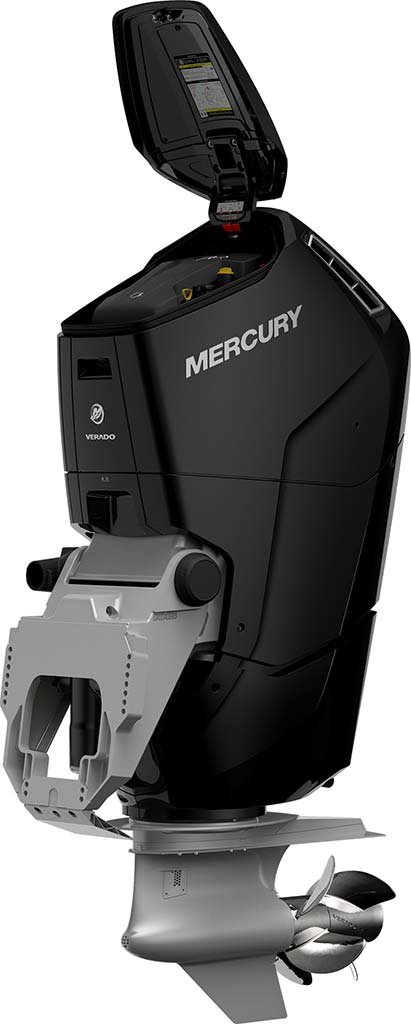
The steerable gearcase. On this engine the powerhead is fixed to the transom, and only the lower gearcase rotates, through up to 45 degrees. Conventional outboards swing the entire engine to steer, which limits how closely multiple engines can be mounted and how far they can turn. Fixing the powerhead allowed Mercury to hold 27-inch center-to-center spacing for multi-engine transoms despite the V12’s size, and 45 degrees of gearcase rotation provides maneuvering authority with no conventional outboard matches.
Contra-rotating propellers. Two propellers on one shaft turning in opposite directions. Each cancels the other’s torque reaction, which eliminates the steering pull a single large propeller generates, and the pair grips considerably more water than one propeller of equivalent diameter. The result is more thrust, a better bite in turns, and neutral handling.
The V12 Powerhead
Displacement is 7.6 liters, 461 cubic inches, in a 64-degree V12 with quad cams and 48 valves, four per cylinder. Bore is 96 mm and stroke is 87 mm, which makes it oversquare and therefore biased toward performance higher in the rev range. The operating range is 5,600 to 6,400 rpm.
The architecture shares its fundamentals with the 4.6-liter V8 introduced in 2018: the same 64-degree cylinder angle, the same dual overhead camshaft principle, and the same four valves per cylinder. Mercury built the V12 on proven foundations rather than starting from nothing.
Mercury’s stated position on this engine is that its industry-leading displacement and quad-cam design generate exceptional torque for propelling heavy boats onto plane, and that because the engine works less, it runs longer. At 600 horsepower from 7.6 liters, that is roughly 79 horsepower per liter, naturally aspirated, which is a moderate specific output for the power produced.
Noise, Access, and Ownership
Reviewers consistently note that the Verado 600 is almost silent at idle and at speed. On a machine this large, that is counterintuitive, and it is deliberate: the powerhead is fixed and isolated, the exhaust is engineered for quietness, and the V12 configuration is inherently well balanced.
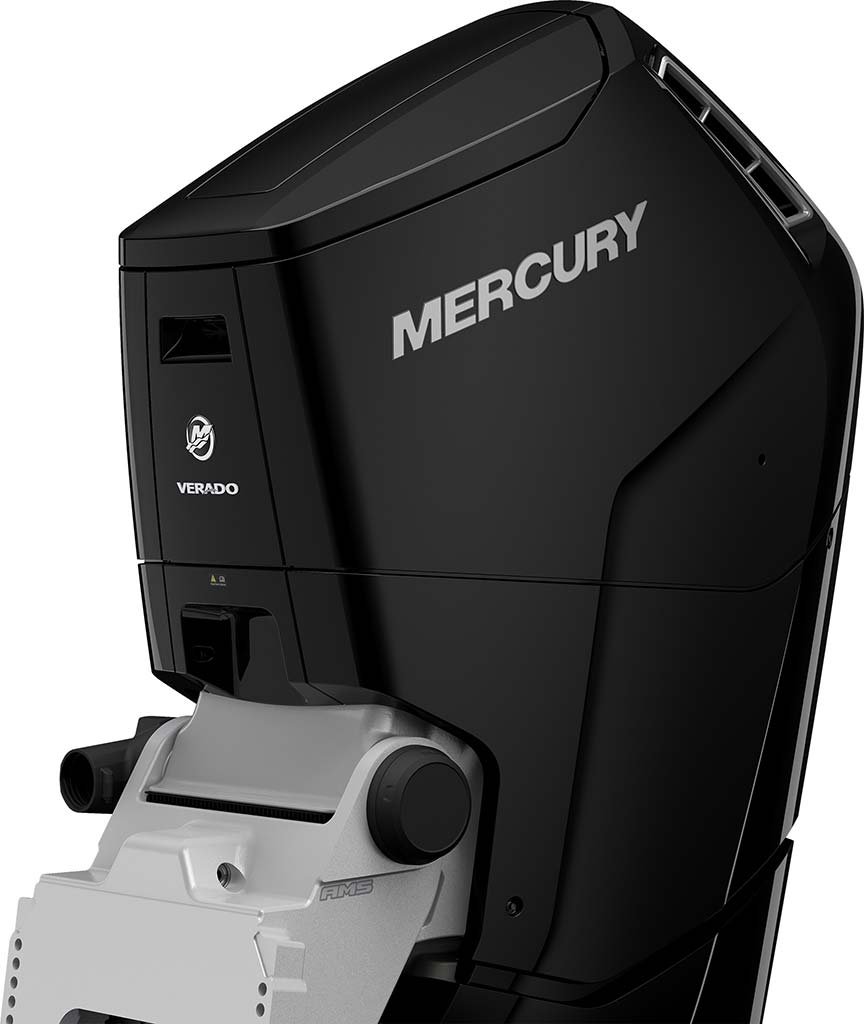
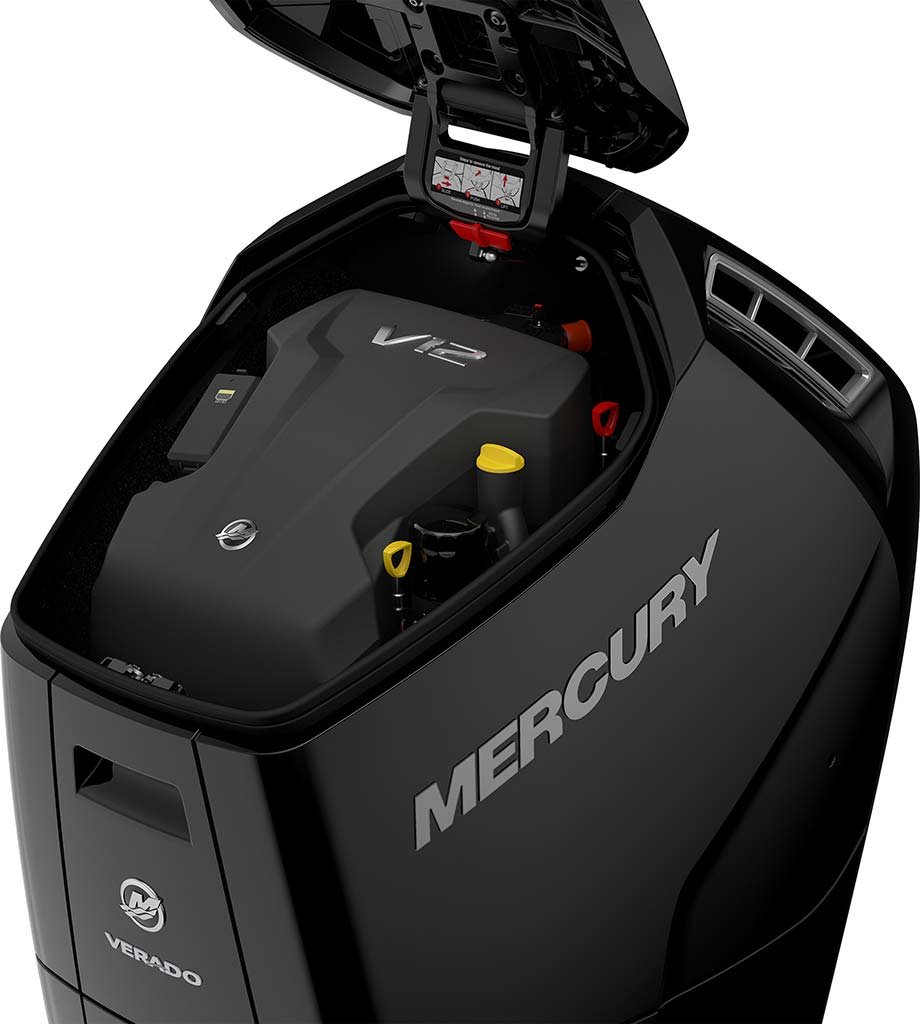
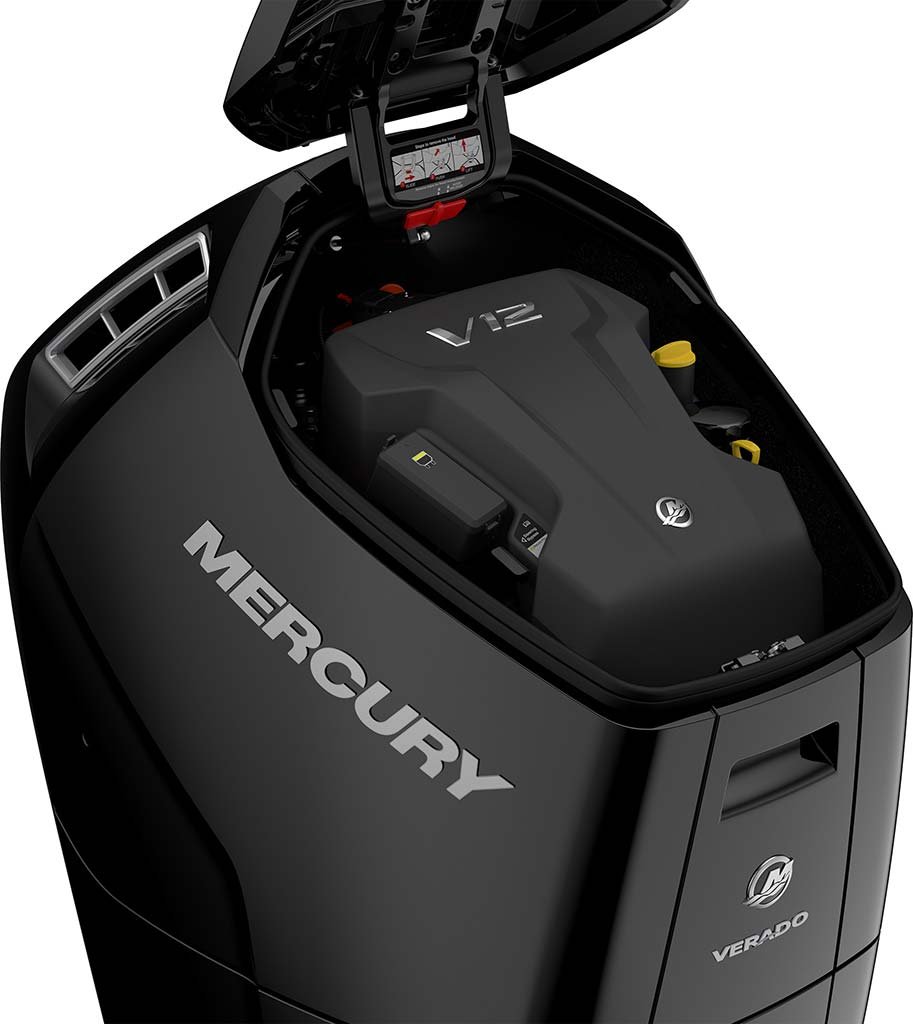
The cowl opens like a car bonnet to provide access for all regular maintenance. On an engine of this size, service access is not a luxury. It determines whether routine work happens on the water or requires a lift.
Shaft lengths run 20, 25, 30, and 35 inches, covering deep-transom and bracket installations on large hulls.
Charging and Steering
The alternator delivers 150 amps, matching the V10 Verado. On a triple or quad V12 installation, that is 450 to 600 amps of combined capacity.
Steering is integrated electro-hydraulic power steering, built into the engine rather than added as a separate system. Combined with the independently steerable gearcase, this arrangement gives close-quarters control that is genuinely unlike a conventional outboard.
Starting is electric with SmartStart protection. Trim is power tilt and trim. Fuel is 87 octane, which on a 600-horsepower engine is remarkable and is the direct consequence of natural aspiration and large displacement.
Weight and Being Honest About It
Dry weight is 1,260 lb / 572 kg in its lightest configuration. That is roughly twice the weight of Mercury’s supercharged 4.6-liter V8 racing engines and nearly double the V10 Verado.
This engine is not a step up from the Verado 400 in the same way that the 400 is a step up from the 350. It is a different class of machine for a different class of boat, generally for hulls above 40 feet, where the transom is engineered for it. Below that, multiple V10 Verados typically give better redundancy, easier service access, and a more sensible weight distribution.
If you are considering a V12, the hull should be designed around it rather than adapted to it.
What It Suits
Sport yachts, large offshore center consoles, and express cruisers from roughly 40 to 60 feet, in twin, triple, or quad installations. This model is the engine Mercury built for hulls that would otherwise require inboard diesels.
Every Mercury Verado 600 we ship is new, factory sealed, and pre-delivery inspected before crating. Multi-engine matched sets are available. Because installations at this level are bespoke, we quote against your specific hull rather than from a list. Compare the Verado 250 to 600 range with the Mercury outboard motors hub. To discuss a V12 installation, please send us your hull details and intended configuration.
Mercury Verado 600 HP V12: Full Factory Specifications
| Feature / Specification | Technical Detail / Value |
|---|---|
| Horsepower | 600 HP |
| Engine type | V12, 64 degrees, quad overhead cam, 48 valves |
| Displacement | 7.6 L / 461 CID |
| Bore and stroke | 96 x 87 mm / 3.8 x 3.4 in |
| Full-throttle RPM range | 5600 to 6400 rpm |
| Induction | Naturally aspirated |
| Fuel system | Electronic fuel injection |
| Recommended fuel | 87 octane |
| Transmission | Two-speed automatic, 1.75:1 low and 2.50:1 high |
| Propellers | Contra-rotating, dual |
| Gearcase | Steerable independently, up to 45 degrees, powerhead fixed |
| Multi-engine spacing | 27 in center-to-center |
| Cooling system | Water-cooled with thermostat |
| Alternator | 150 amp |
| Starting | Electric with SmartStart protection |
| Steering | Integrated electro-hydraulic power steering |
| Shaft lengths | 20 in, 25 in, 30 in, 35 in |
| Trim system | Power tilt and trim |
| Service access | Full-opening cowl for all regular maintenance |
| SmartCraft compatible | Yes. |
| Dry weight | 1,260 lb / 572 kg (lightest configuration) |
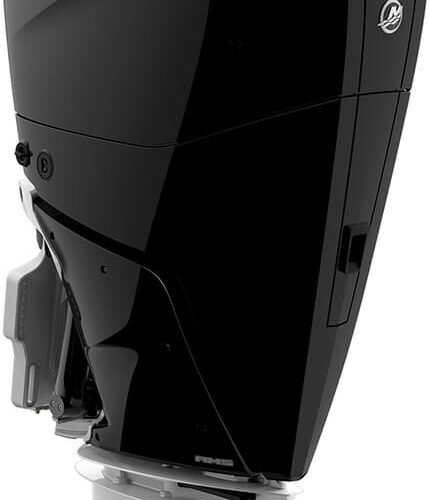
| Color | Phantom Black |
| Condition | New, factory sealed, PDI completed |
Frequently Asked Questions
Does the Mercury Verado 600 really have a two-speed gearbox?
Yes. The Verado 600 carries a two-speed automatic transmission, which is an outboard industry first. It runs a 1.75:1 ratio at low revs to multiply torque and lift a heavy hull onto plane, then automatically shifts to 2.50:1 for efficient cruising once planing. Every other outboard in production has a single fixed gear ratio.
How does the steerable gearcase on the Verado 600 work?
The powerhead is fixed to the transom, and only the lower gearcase rotates, through up to 45 degrees. Conventional outboards swing the entire engine to steer. Fixing the powerhead lets Mercury maintain 27-inch center-to-center spacing for multiple engines despite the V12’s size, and 45 degrees of gearcase rotation provides close-quarters maneuvering authority with no conventional outboard matches.
Why does the Verado 600 use contra-rotating propellers?
Two propellers on one shaft turning in opposite directions cancel each other’s torque reaction, which removes the steering pull a single large propeller produces. The pair also grips considerably more water than one propeller of equivalent diameter, producing more thrust and better bite through turns with neutral handling.
What fuel does the Mercury Verado 600 require?
87 octane. Despite producing 600 horsepower, the V12 is naturally aspirated and reaches its output through 7.6 liters of displacement rather than forced induction, so it does not carry the premium fuel requirement a boosted engine of comparable output would.
How much does the Mercury Verado 600 weigh?
1,260 lb (572 kg) in the lightest configuration, roughly double the V10 Verado. This engine suits hulls above approximately 40 feet with transoms engineered for it. On smaller boats, multiple V10 Verados generally give better redundancy, easier service access, and more sensible weight distribution.
Is the Verado 600 quiet?
Yes, remarkably so for its size. Reviewers consistently describe it as almost silent at idle and at speed. The fixed, isolated powerhead, the engineered exhaust, and the inherent balance of a V12 configuration all contribute. Quietness was an explicit design target rather than a side effect.