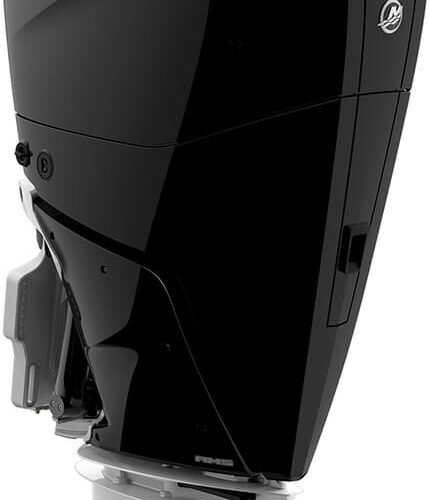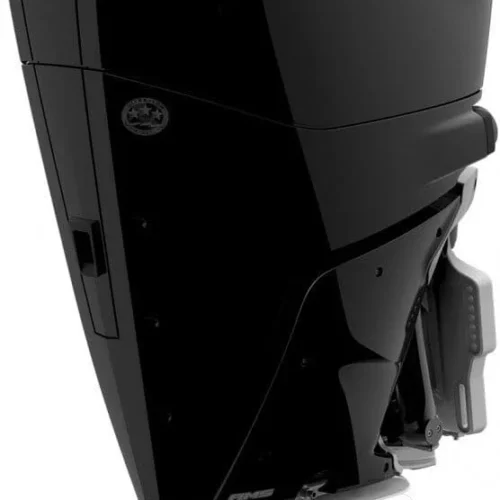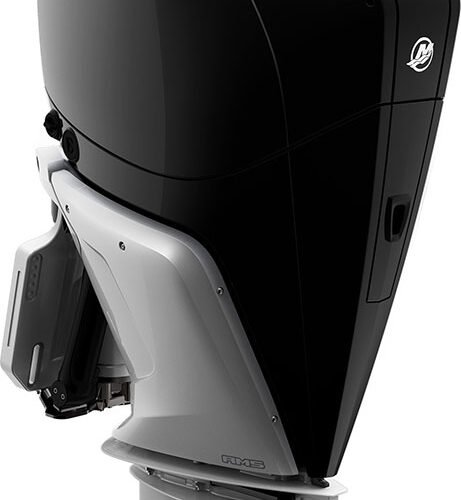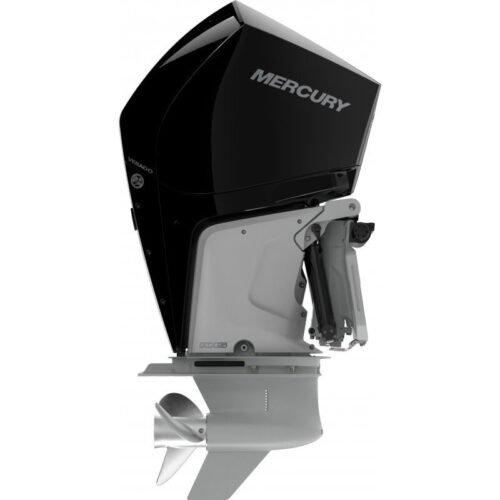
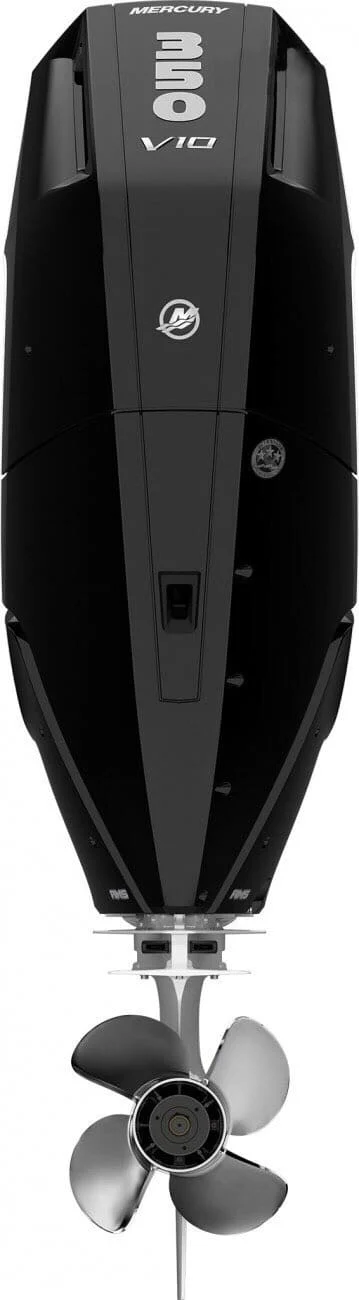
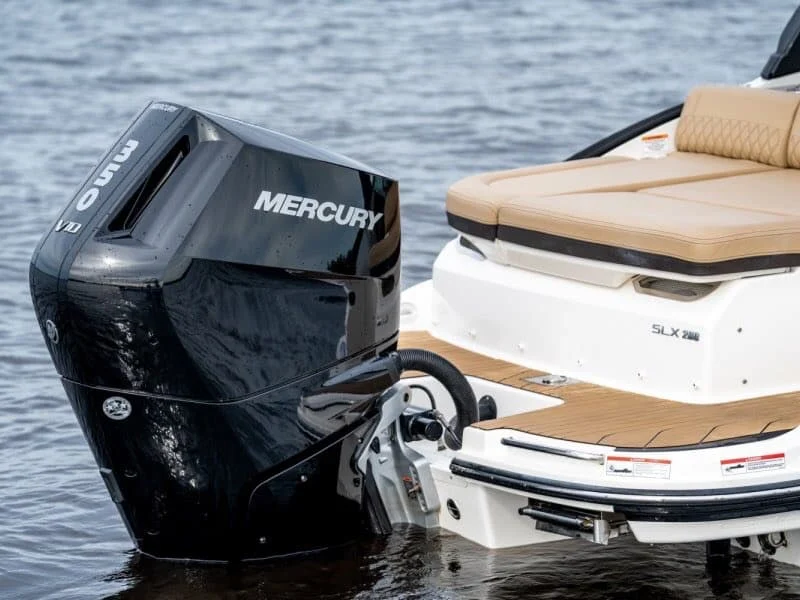

Description
The First V10 Outboard
Mercury introduced the V10 Verado as an industry first, and it exists to solve a specific problem: replacing the supercharged 2.6-liter Verado L6, which had served since 2004.
The L6 made its power through forced induction. The V10 makes more, with 5.7 liters of naturally aspirated displacement. Mercury’s internal philosophy on this is blunt and worth repeating: there is no replacement for displacement. Removing the supercharger removes a belt, an intercooler, a boost control system, and their combined maintenance and failure modes.
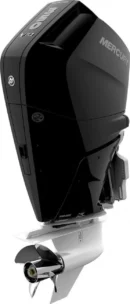
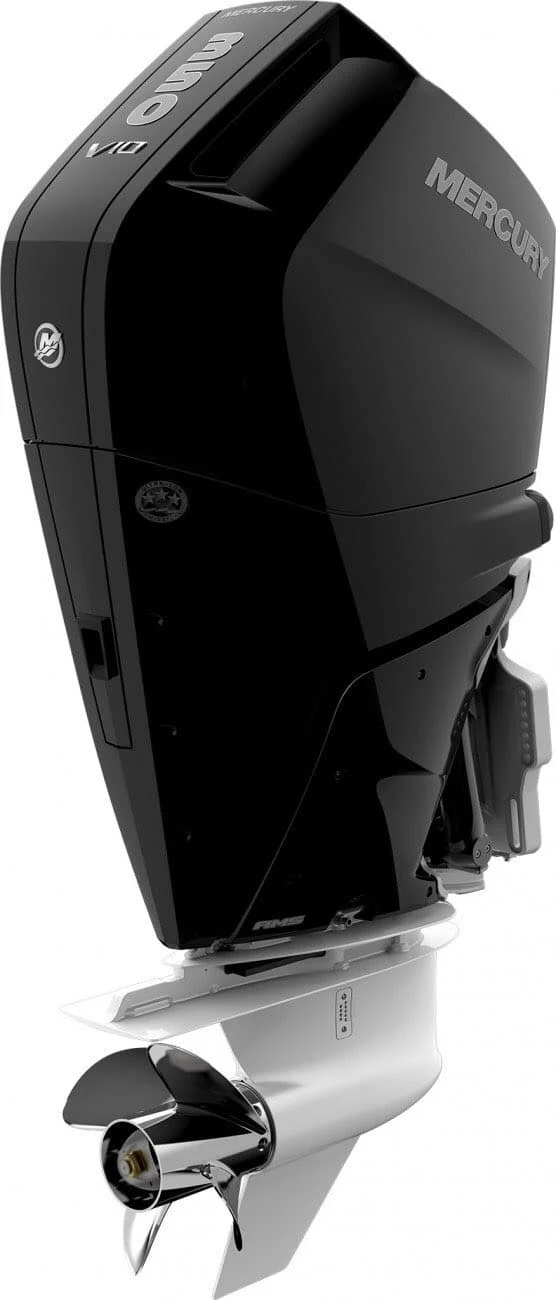
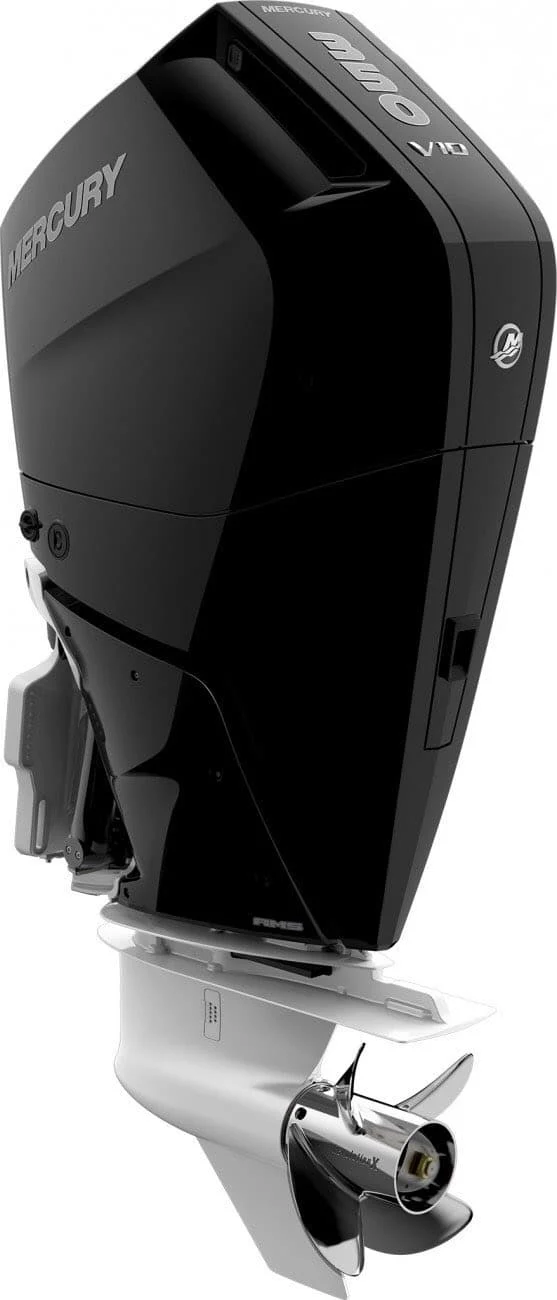
The powerhead is a 64-degree V10 with quad cams and 40 valves, four per cylinder, with independent intake and exhaust timing on both banks. The bore and stroke are 92 x 86 mm, the same dimensions as the 4.6-liter V8, which is Mercury reusing proven architecture at a greater scale. The operating range is 5,800 to 6,400 rpm.
The Gearcase and Propeller Are the Real Story
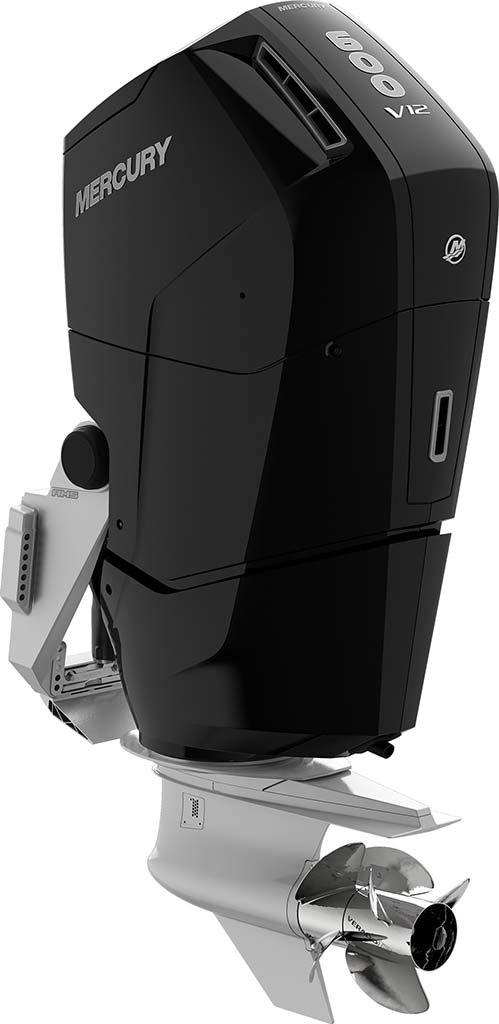
Mercury designed a new 6.4-inch-diameter gearcase specifically for the V10, a full inch larger than previous Verado models. It runs a 2.08:1 ratio.
That combination exists to power large, heavy boats. A bigger gearcase swings a bigger propeller, and the 2.08:1 ratio multiplies torque rather than chasing propeller speed. The Revolution X propeller supplied as standard carries roughly 50 percent more blade surface area than the propeller fitted to the previous Verado L6.
Fifty percent more blade area is an enormous change. The blade area is what converts engine torque into thrust, and on a heavy boat it is the single biggest factor in whether the hull comes onto plane cleanly or wallows through the transition. Combined with the displacement, this is an engine designed to move weight.
If your boat is heavy, this drivetrain is the argument for the V10 over twin smaller engines.
Charging: 150 Amps at 1,500 RPM
The alternator specification on this engine deserves its own section because it is genuinely class-leading.
150 amps at 1,890 watts, delivered at just 1,500 rpm. That is more than twice the output of the 2.6-liter Verados it replaced and roughly 30 percent more than the V8 Verados. For external comparison, competing engines in this class produce considerably less.
The rpm figure matters as much as the amperage. An alternator that only reaches full output at cruise is useless at anchor, at idle, or trolling. Reaching 150 amps at 1,500 rpm means the engine charges properly through the conditions where boats actually drain their batteries. Idle Charge monitors battery voltage on the water and raises idle rpm automatically when it needs more output.
An optional dual-mode 48V/12V alternator is available, designed to pair with lithium-ion auxiliary power systems. The intent is to eliminate the onboard generator entirely on boats that would otherwise need one. If you are specifying a new build with a lithium house bank, this option is worth investigating at order rather than retrofitting.
Steering, Shafts, and Rigging
Steering is electro-hydraulic with fully electric available as an option. Shaft lengths run 20 inches, 25 inches, 30 inches, and 35 inches, which covers deep-transom and bracket installations on large hulls. Trim is power trim and tilt. Starting is electric with SmartStart protection.
Dry weight is 695 lb (316 kg) in the lightest configuration, rising to around 709 lb on the 25-inch shaft. Check your transom rating carefully: this is a substantially heavier engine than the V8 Verado at 600 lb.
The engine is SmartCraft compatible across Mercury’s digital ecosystem.
What It Suits
Large center consoles, sport fishing boats, express cruisers, and sport yachts from roughly 30 to 40 feet, typically in twin or triple installations. Also single-engine on large, heavy hulls where torque matters more than top speed.
Every Mercury Verado 350 we ship is new, factory sealed, and pre-delivery inspected before crating. Multi-engine matched sets with counter-rotation are available on request. Compare across the Verado 250 to 600 range, step down to the V8 Verado 250 and 300, or browse the Mercury outboard motors hub. For rigging, propeller selection, or multi-engine quotes, send us your hull details.
Mercury Verado 350 HP V10: Full Factory Specifications
| Feature / Specification | Technical Detail / Value |
|---|---|
| Horsepower | 350 HP |
| Engine type | V10, 64 degrees, quad overhead cam, 40 valves |
| Displacement | 5.7 L / 349 CID |
| Bore and stroke | 92 x 86 mm |
| Full-throttle RPM range | 5800 to 6400 rpm |
| Induction | Naturally aspirated, performance-tuned intake manifold |
| Fuel system | Electronic fuel injection |
| Recommended fuel | Unleaded regular, 87 octane minimum |
| Ignition | SmartCraft digital |
| Cooling system | Water-cooled with thermostat |
| Alternator | 150 amp / 1,890 W at 1,500 rpm, with Idle Charge |
| Optional alternator | Dual-mode 48V/12V for lithium auxiliary systems |
| Starting | Electric with SmartStart protection |
| Steering | Electro-hydraulic, fully electric, optional |
| Gear shift | Forward, Neutral, Reverse |
| Gearcase ratio | 2.08:1 |
| Gearcase diameter | 6.4 in |
| Standard propeller | Revolution X, approx. 50% more blade area than Verado L6 |
| Shaft lengths | 20 in, 25 in, 30 in, 35 in |
| Trim system | Power trim and tilt |
| SmartCraft compatible | Yes. |
| Dry weight | 695 to 709 lb / 316 to 322 kg by configuration |
| Color | Phantom Black |
| Condition | New, factory sealed, PDI completed |
Frequently Asked Questions
Is the Mercury Verado 350 V10 supercharged?
No. The V10 Verado is naturally aspirated, reaching 350 horsepower through 5.7 liters of displacement. It replaced the supercharged 2.6-liter Verado L6, and removing forced induction eliminated the supercharger, the intercooler, the drive belt, and their combined maintenance requirements while producing more torque.
How much charging power does the Verado 350 V10 produce?
150 amps at 1,890 watts, delivered at just 1,500 rpm. That is more than twice the output of the 2.6-liter Verados it replaced and roughly 30 percent above the V8 Verados. Reaching full output at 1,500 rpm matters because it charges properly at idle and while trolling, which is where boats actually drain batteries.
What is the Revolution X propeller?
Revolution X is the propeller supplied as standard with the V10 Verado, carrying roughly 50 percent more blade surface area than the propeller fitted to the previous Verado L6. The blade area converts engine torque into thrust, so on a heavy boat it is the main factor in whether the hull planes cleanly. It pairs with the new 6.4-inch gearcase designed specifically for this engine.
What is the dual-mode 48V/12V alternator option?
It is an optional alternator that supplies both 48-volt and 12-volt outputs, designed to pair with lithium-ion auxiliary power systems. The intent is to eliminate the need for a separate onboard generator on boats that would otherwise require one. Specify it at order if you are building with a lithium house bank, since retrofitting is considerably more involved.
How heavy is the Mercury Verado 350 V10?
695 lb (316 kg) in the lightest configuration, rising to around 709 lb on longer shafts. That is roughly 95 lb more than the V8 Verado 300 at 600 lb. Check both the horsepower and weight limits on your transom capacity plate before ordering, since the V10 is a substantially larger installation.