
Description
What 1,000 Extra RPM Buys You
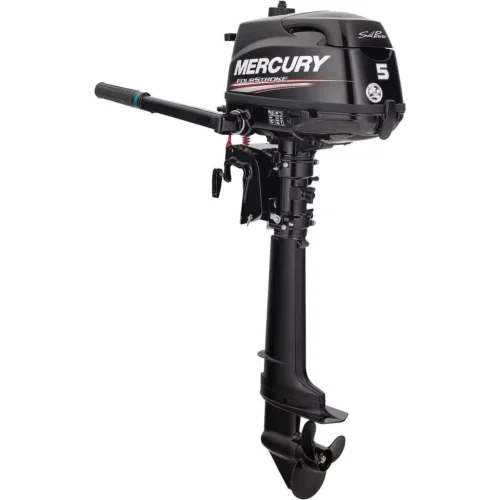
The Mercury 6 HP shares its 123 cc powerhead, 59 x 45 mm bore and stroke, 2.15:1 gearcase, and six-position trim with the 4 HP and 5 HP. On a spec sheet the three look nearly identical. The difference sits in one line: wide open throttle range. The 4 HP and 5 HP run 4500 to 5500 rpm. The 6 HP runs from 5000 to 6000.
That thousand rpm is the key point. Power is torque times engine speed, so spinning the same displacement faster produces more horsepower from identical hardware, and Mercury tunes the intake, carburetor, and exhaust to support it. What you feel on the water is top-end thrust. The 5 HP pushes a heavy hull comfortably at displacement speed. The 6 HP will get a lightly loaded planing dinghy up and over onto the plane, which the 5 HP will not reliably do.
Sea trial data from independent tests on this engine puts a typical tender at around 12 knots at wide open throttle, burning roughly 2 liters per hour, and cruising at around 11.9 knots at 4900 rpm on 1.7 liters per hour. The engine is close to its most efficient point at cruise, which is unusual and worth knowing: on this model, backing off from wide-open throttle costs you almost no speed and saves 15 percent of your fuel.
Against the direct four-stroke competition, the 6 HP runs a smaller displacement. Mercury trades displacement for revs, and the practical result is better fuel efficiency for the same output. On an engine whose integrated tank holds 1.1 liters, efficiency is not an abstraction.
Hardware, Fueling, and the Tilt Lock
The two-valve pushrod overhead valve head uses gear-driven pushrod actuation of the rocker gear rather than a belt or chain, meaning there is no timing component with a replacement interval. Ignition is CDI with electronic spark advance. Cooling runs through a thermostat.
Fueling is the same dual arrangement as the 4 and 5 HP: a 0.3 gallon (1.1 liter) integrated tank under the cowl with an external fuel shutoff valve, plus the option of a 3.2 gallon (12 liter) remote tote tank. Mercury supplies both tank options without compromising powerhead access, which is not true of every competitor in this class. One practical warning: on the remote tote, the fuel line does not detach from the tank, which makes cleaning the tank filter screen awkward. Budget the extra ten minutes at service time.
The auto tilt lock is a small feature that matters more than the spec sheet suggests. Tilting the leg fully clear and having it hold without a manual latch is what you want when you are beaching a tender single-handed or lifting the leg under sail to kill drag.
Trim is six positions with a shallow water drive setting and a 16-degree range. Exhaust discharges through the propeller hub. Gear shift is forward, neutral, and reverse on a lever. An optional alternator is available at 4 amps lighting and 2 amps charging (50 watts lighting, 25 watts charging) if you need to run navigation lights or trickle a battery.
Weight, Handling, and Who Should Buy It
Dry weight is 57 lb / 26 kg, the same as the 5 HP. Mercury lists it among the lightest 6 HP outboards on the market, and that claim holds against most of the four-stroke field. It is still a two-handed lift with a planned route from car to transom.
Buy the 6 HP if you want a planing dinghy, if you carry three people in a tender, or if you run a small jon boat as a primary fishing platform. Buy the 5 HP instead; if your hull is a displacement sailboat or a heavy load, you will never plane anyway, because the 5 HP’s lower rev band suits that duty better and costs less.
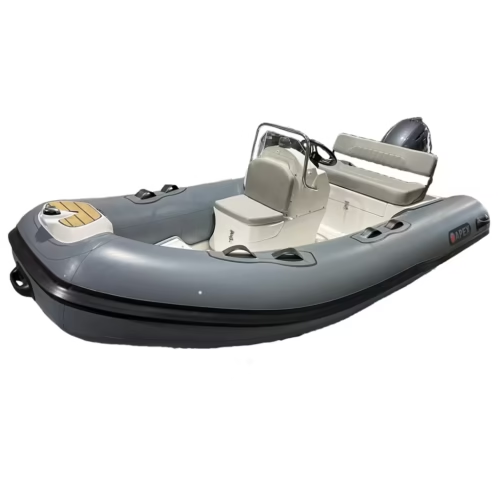
Every Mercury 6 HP outboard we ship is new, factory sealed, and pre-delivery inspected before crating. Compare across the full Cool Compacts range, where the 8 HP moves to a twin-cylinder block. For hull matching, see our inflatable boats and tenders and the Apex dinghy range. The direct cross-brand comparison in stock is the Yamaha F6 portable outboard.
Mercury 6 HP FourStroke: Full Factory Specifications
| Feature / Specification | Technical Detail / Value |
|---|---|
| Models | 6MH (15″ shaft), 6MLH (20″ shaft) |
| Horsepower | 6 HP / 4.4 kW |
| Engine type | 1 cylinder, four-stroke |
| Displacement | 123 cc / 7.5 CID |
| Bore and stroke | 59 x 45 mm / 2.32 x 1.77 in |
| Full throttle RPM range | 5000 to 6000 rpm |
| Fuel induction | 2-valve pushrod (overhead valve) |
| Fuel system | Carbureted |
| Recommended fuel | 87 octane, up to 10% ethanol |
| Recommended oil | Mercury FourStroke 10W-30 |
| Ignition | CDI with electronic spark advance |
| Cooling system | Water-cooled with thermostat |
| Starting | Manual (recoil) |
| Steering | Tiller |
| Gear shift | Forward, Neutral, Reverse |
| Gearcase ratio | 2.15:1 |
| Alternator | Optional, 4 amp lighting / 2 amp charging (50 W / 25 W) |
| Shaft lengths | 15 in / 381 mm, 20 in / 508 mm |
| Trim system | Manual, 6 positions, auto tilt lock |
| Shallow water drive | Yes, 16-degree range |
| Exhaust system | Through the propeller |
| Integrated fuel tank | 0.3 gal / 1.1 L with external shutoff valve |
| Optional remote tank | 3.2 gal / 12 L |
| Dry weight | 57 lb / 26 kg |
| Engine protection | Low oil pressure, over-rev |
| CARB star rating | 3 stars |
| Colour | Phantom Black |
| Saltwater rated | Yes. |
| Condition | New, factory sealed, PDI completed |
Frequently Asked Questions
What is the difference between the Mercury 5 HP and 6 HP outboard?
Both use the identical 123 cc powerhead, gearcase, and trim system, and both weigh 57 lb. The difference is the operating range: the 5 HP runs 4500 to 5500 rpm, and the 6 HP runs 5000 to 6000 rpm. That extra thousand rpm gives the 6 HP more top-end thrust, enough to plane a lightly loaded dinghy. The 5 HP is suited for displacement hulls and sailboat auxiliary duty.
Will a 6 hp outboard motor plane a dinghy?
Yes, a 6 hp outboard motor will plane a lightly loaded inflatable or aluminum dinghy of roughly 10 to 12 feet with one to two occupants. Sea trial data on this engine shows around 12 knots at wide open throttle on a typical tender. Add a third adult or heavy gear, and the hull will drop off the plane, which is the point where you should be considering the 8 HP or 9.9 HP instead.
How much fuel does the Mercury 6 HP use?
Independent sea trials record roughly 1.7 liters per hour at a 4900 rpm cruise and 2 liters per hour at wide open throttle. The 1.1-liter integrated tank therefore gives around 40 minutes of running, while the optional 12-liter remote tank gives a full day. Cruising rather than running flat out costs almost no speed on this engine and saves around 15 percent of your fuel.
Does the Mercury 6 HP outboard have an alternator?
An alternator is available as an option, rated at 4 amps lighting and 2 amps charging (50 watts and 25 watts). It is not fitted as standard. If you need to run navigation lights or maintain a small battery, specify it in the order. For anything beyond light charging duty, the 8 HP and 9.9 HP carry a considerably larger alternator as standard.
Which shaft length should I order for the Mercury 6 HP?
Measure from the top of your transom board to the bottom of the hull. Up to 17 inches, order the 15-inch shaft (6MH). Above 17 inches, order the 20-inch shaft (6MLH). A shaft that is too short allows the propeller to ventilate in chop and loses thrust. A shaft slightly too long adds a little drag but is the safer of the two errors.